
Table of Contents

Key Takeaways
- The EB-3 visa covers three distinct worker categories: skilled workers, professionals, and other (unskilled) workers, each with different qualification thresholds.
- Every EB-3 petition requires an employer to obtain labor certification through the PERM process, confirming no qualified U.S. worker is available and that the foreign worker will receive the prevailing wage.
- Processing timelines can extend from one to five years, and priority dates vary significantly by country of birth, making early planning important for both employers and employees.
Many foreign-born employees qualify for an EB-3 visa in the United States. However, not every business is aware of how to sponsor an EB-3 employee, and similarly, many prospective visa holders are not sure how to prove that they qualify. Brown Immigration Law is available to help both employers and employees nationwide understand the requirements for EB-3 immigration. With offices in Florida, North Carolina, and Ohio, our attorneys are available to help answer questions, handle paperwork, fight a denial, and build an employment immigration law strategy that works for your needs.
Who Is Eligible for an EB-3 Visa?
Unlike the more restrictive EB-1 and EB-2 visas, EB-3 visas are available to a broader category of worker in the United States. However, there are caps on how many EB-3 visas are available; they make up only 28.6% of the 140,000 permanent employment visas offered. This creates high demand and many competitive applicants may be denied.
Working with a skilled US immigration attorney from Brown Immigration Law may increase your chances of receiving an EB-3 visa if you are a qualified candidate. The three categories for EB3 visas are:
| Category | Who Qualifies? | Minimum Requirement |
|---|---|---|
| Skilled Workers | Jobs requiring at least two years of training or experience | 2+ years of experience or training |
| Professionals | Occupations requiring at least a bachelor’s degree | U.S. bachelor’s degree or foreign equivalent |
| Other Workers | Jobs requiring less than two years of training or experience | Permanent job offer |
Skilled workers
Skilled workers must have a labor certification, and will have at least two years of experience or training in their field in order to meet Schedule A requirements. You may be asked to supply your official academic transcript and records, as well as supplemental letters from current or former employers. Many successful applicants as skilled workers may also demonstrate relevant post-secondary education as training, such as a masters degree or equivalent.
Professionals
For professionals, you must demonstrate that you hold at least a US bachelor’s or foreign equivalent degree. Your employment must require at least a bachelor’s degree in order to enter into the occupation as well as a labor certification. Additionally, you may be asked to show that you meet the job requirements, as well as provide your academic records and transcripts. Relevant experience may not be substituted for these credentials.
Other workers
To qualify as an unskilled worker for an EB3 visa, you must have a labor certification from your US-based employer that requires less than two years experience or training. You must meet all of the qualifications to perform this role.
Need Help With an EB3 Visa?

What Are the EB-3 Visa Requirements?
EB-3 requirements include a permanent, full-time job offer from a US-based employer. They must provide a labor certification, or application for a Schedule A designation, in order to petition on your behalf. Because of this, EB-3 visas are often utilized by businesses looking to hire outside of the US.
Requirements for Workers
Workers generally need:
- Permanent, full-time job offer
- Required education or experience
- Academic transcripts (if applicable)
- Employment verification letters
- Biometrics appointment
- Supporting immigration documentation
Requirements for Employers
Employers generally must:
- Offer a permanent, full-time position
- Obtain PERM labor certification (unless exempt)
- File Form I-140
- Demonstrate ability to pay the prevailing wage
- Provide supporting documentation
About Labor Certification for the EB3 Visa
EB3 visas are an employment-based immigration strategy. These third-preference visas must be backed by a labor certification from a valid US employer that shows that qualified US workers are not available for the job. This labor certification must also demonstrate that the foreign candidate will be paid the prevailing wage.
The only exception available is for designated Schedule A positions. Current examples include professional nurses and physical therapists, or any other role that the Department of Labor has deemed is in short supply in the US workforce. These roles may be able to bypass filing for PERM labor certification.
| PERM Labor Certification | Schedule A |
|---|---|
| Required for most EB-3 cases | Available only for designated shortage occupations |
| Employer completes recruitment | Recruitment generally not required |
| Department of Labor reviews labor market | Bypasses the traditional PERM process |
How the EB-3 Visa Process Works
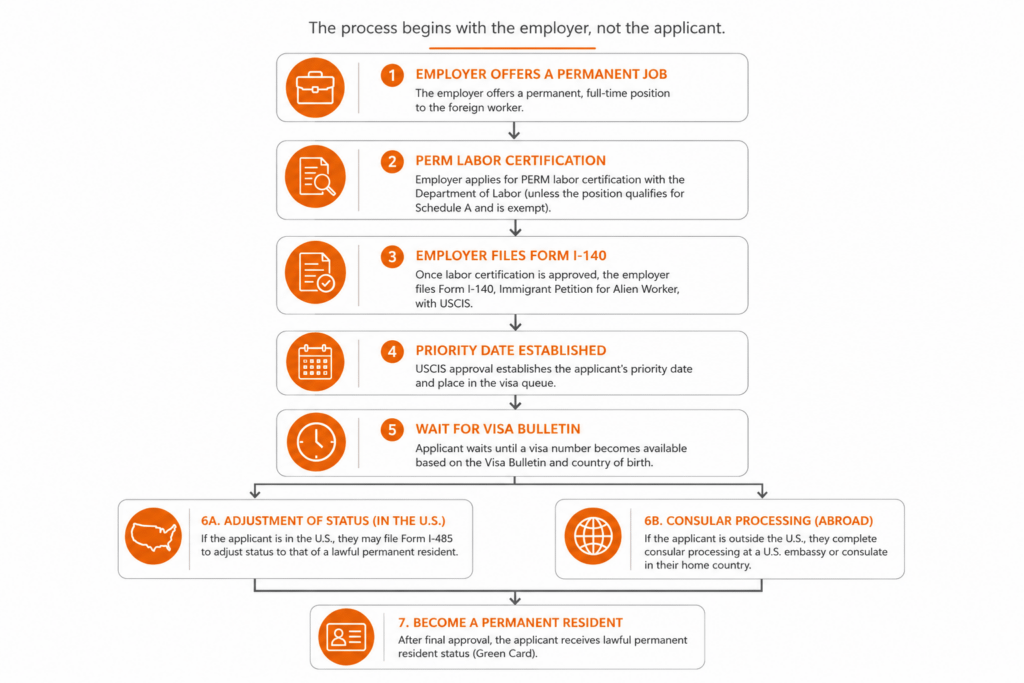
The process begins with the employer, not the applicant.
The employer first applies for PERM labor certification through the Department of Labor, documenting recruitment efforts and demonstrating no qualified U.S. worker was available. Roles under Schedule A designations, such as registered nursing or physical therapy, may bypass this filing entirely.
Once labor certification is approved, the employer files Form I-140 with U.S. Citizenship and Immigration Services. Approval establishes the applicant’s priority date and their place in the visa queue.
The applicant then waits for that date to become current. For applicants born in high-demand countries, this wait can extend for years. Attorneys monitoring the monthly Visa Bulletin can help employers and applicants respond to retrogression before it stalls a case. Our attorneys handling employment-based immigration track these dates for clients actively.
When a visa number becomes available, the applicant files for adjustment of status if already in the U.S., or completes consular processing abroad.
What Is the Average EB-3 Processing Time?
Completing all of the EB-3 steps can vary widely, based on employer responsiveness, your country of origin, changes to US immigration policy, delays from academic institutions regarding transcripts, and other issues that might arise.
This is rough estimate of how it could work:
| Step | What Happens | Typical Wait |
|---|---|---|
| Prevailing Wage Determination | Employer requests prevailing wage from the Department of Labor. | Varies |
| PERM Labor Certification | Employer completes recruitment and files PERM. | Varies |
| Form I-140 | Employer files the immigrant petition with USCIS. | Standard or Premium Processing available |
| Priority Date Wait | Applicant waits until a visa number becomes available. | Depends on country of birth and Visa Bulletin |
| Green Card Application | Adjustment of Status or Consular Processing. | Varies |
While many steps have published processing estimates, the overall timeline is often driven by visa availability. Applicants born in countries with high demand may wait significantly longer than applicants from other countries. Applying for a green card after receiving an EB-3 visa can take more time as well. However, receiving an EB-3 visa is a promising first step to permanent residency for foreign workers.

In the realm of employment-based immigration processes, we can often present both short- and long-term immigration options as we work through a potential client’s education, experience, and unique professional profile. Because we know what questions to ask and variables to look for, what may initially seem unimportant or inconsequential can change the entire trajectory of a case.
– Kathryn P. Russell, Partner at Brown Immigration Law
How Much Does an EB 3 Visa Cost?
There is a $715 filing fee as well as an additional $235 immigrant fee that must be paid when applying for an EB 3 visa. An adjustment of status application can increase your cost by $1440 when filed after an EB 3 visa. There may be additional fees that apply to your situation, as well as legal costs and expenses.
How Our Immigration Lawyers Can Help With EB-3 Visas
At Brown Immigration Law, our attorneys are dedicated to securing you and your company’s future. Our immigration lawyers can help by:
- Determining the appropriate EB-3 category
- Preparing PERM and I-140 filings
- Tracking Visa Bulletin priority dates
- Responding to Requests for Evidence
- Handling denied or delayed petitions
- Advising employers throughout the sponsorship process
Contact Brown Immigration Law for Help with EB3 Visas
With over ten decades of experience combined on our staff, Brown Immigration Law is confident that we can match you with the best immigration attorney for your needs. Contact us to get started on an EB-3 visa and any additional paperwork necessary for your case. Our offices are located in Cleveland, Columbus, Raleigh-Durham, Tampa, and Orlando, and we assist clients nationwide with immigration concerns. Call us today at 888-861-4414 or get in touch via our contact form.
Frequently Asked Questions About EB3 Visas
Can my spouse and children accompany me?
Dependent spouses and unmarried children under 21 may qualify as derivative beneficiaries. They are included in the primary applicant’s case rather than filing separate petitions.
What if my employer withdraws the I-140 before my green card is approved?
If your I-140 has been approved for 180 days or more and you are in the adjustment of status stage, AC21 portability rules may allow you to move to a new qualifying job without restarting the process.
Does my priority date change if I switch EB-3 subcategories?
A new petition is typically required, though the original priority date may be retained in some circumstances.
What is priority date retrogression?
Retrogression occurs when the Department of State moves a priority date backward due to high demand. It can delay final steps even after I-140 approval.
Can I work for a different employer while waiting?
Under AC21, applicants in the adjustment of status stage may change employers if the new position is in the same or similar occupational classification and meets other eligibility requirements.
Does the process differ for applicants outside the United States?
Yes. Applicants abroad go through consular processing at a U.S. embassy or consulate rather than filing for adjustment of status. The interview and final approval occur outside the U.S.